Frank R. Paul's Martian Telescope Views New York, Amazing Stories 1929
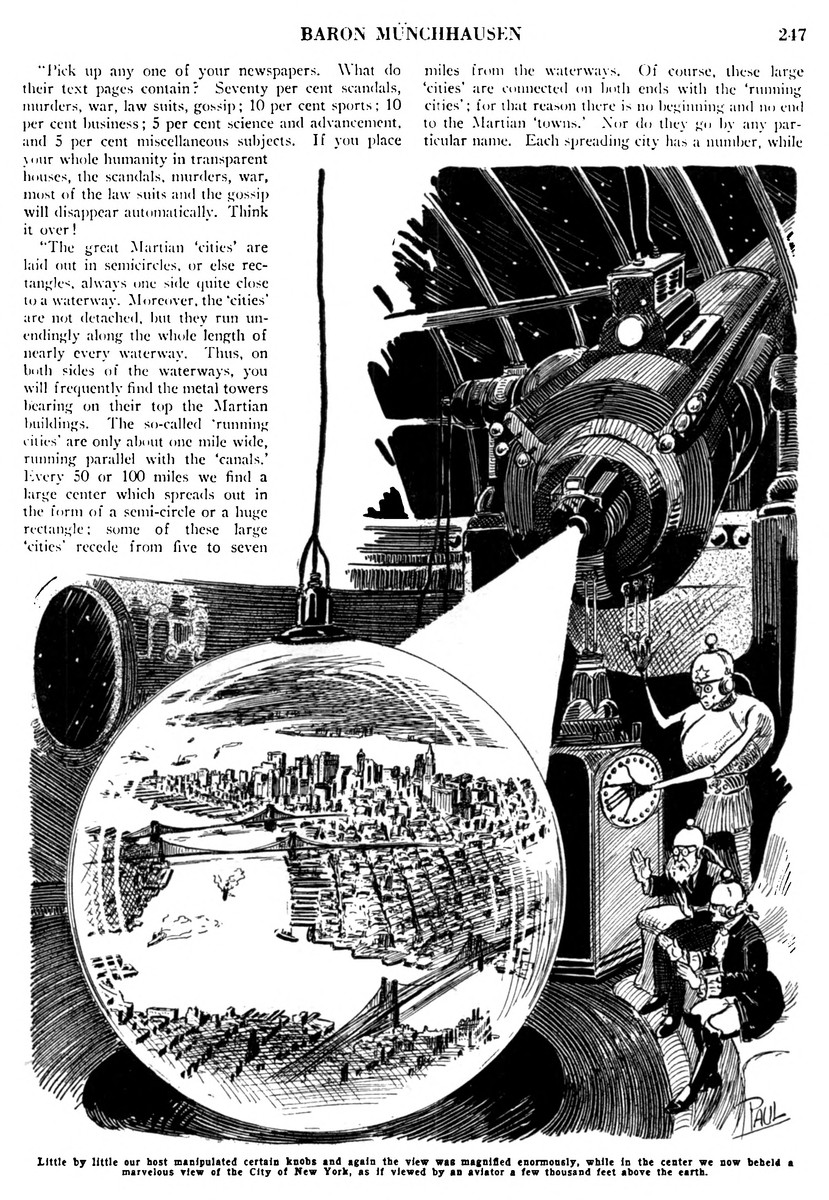
Wonder radiates from every inch of this intricate pen-and-ink spread — a towering Martian telescope apparatus dominates the frame while two goggled alien observers peer intently at controls, their gaze directed toward a circular magnified view of New York City seen from above, bridges and skyscrapers rendered in astonishing detail. The juxtaposition of alien technology and the familiar Manhattan skyline creates a breathtaking sense of cosmic surveillance, as if humanity is blissfully unaware of extraterrestrial eyes watching from across space.
The most outrageous detail is the Martian observers using a colossal interplanetary telescope to spy on New York City in real-time, rendering Manhattan's skyline in a glowing circular viewport like a cosmic crystal ball. Only Frank R. Paul could make alien surveillance feel both scientifically earnest and wildly spectacular.
“BARON MÜNCHHAUSEN 247 "Pick up any one of your newspapers. What do their text pages contain? Seventy per cent scandals, murders, war, law suits, gossip; 10 per cent sports; 10 per cent business; 5 per cent science and advancement, and 5 per cent miscellaneous subjects. If you place your whole humanity in transparent houses, the scandals, murders, war, most of the law suits and the gossip will disappear automatically. Think it over! "The great Martian 'cities' are laid out in semicircles, or else rectangles, always one side quite close to a waterway. Moreover, the 'cities' are not detached, but they run unendingly along the whole length of nearly every waterway. Thus, on both sides of the waterways, you will frequently find the metal towers bearing on their top the Martian buildings. The so-called 'running cities' are only about one mile wide, running parallel with the 'canals.' Every 50 or 100 miles we find a large center which spreads out in the form of a semi-circle or a huge rectangle; some of these large 'cities' recede from five to seven miles from the waterways. Of course, these large 'cities' are connected on both ends with the 'running cities'; for that reason there is no beginning and no end to the Martian 'towns.' Nor do they go by any particular name. Each spreading city has a number, while Little by little our host manipulated certain knobs and again the view was magnified enormously, while in the center we now beheld a marvelous view of the City of New York, as if viewed by an aviator a few thousand feet above the earth. PAUL”