G. Harold's 1928 Mechanical Man Anatomy Diagram — Robot as Human Body
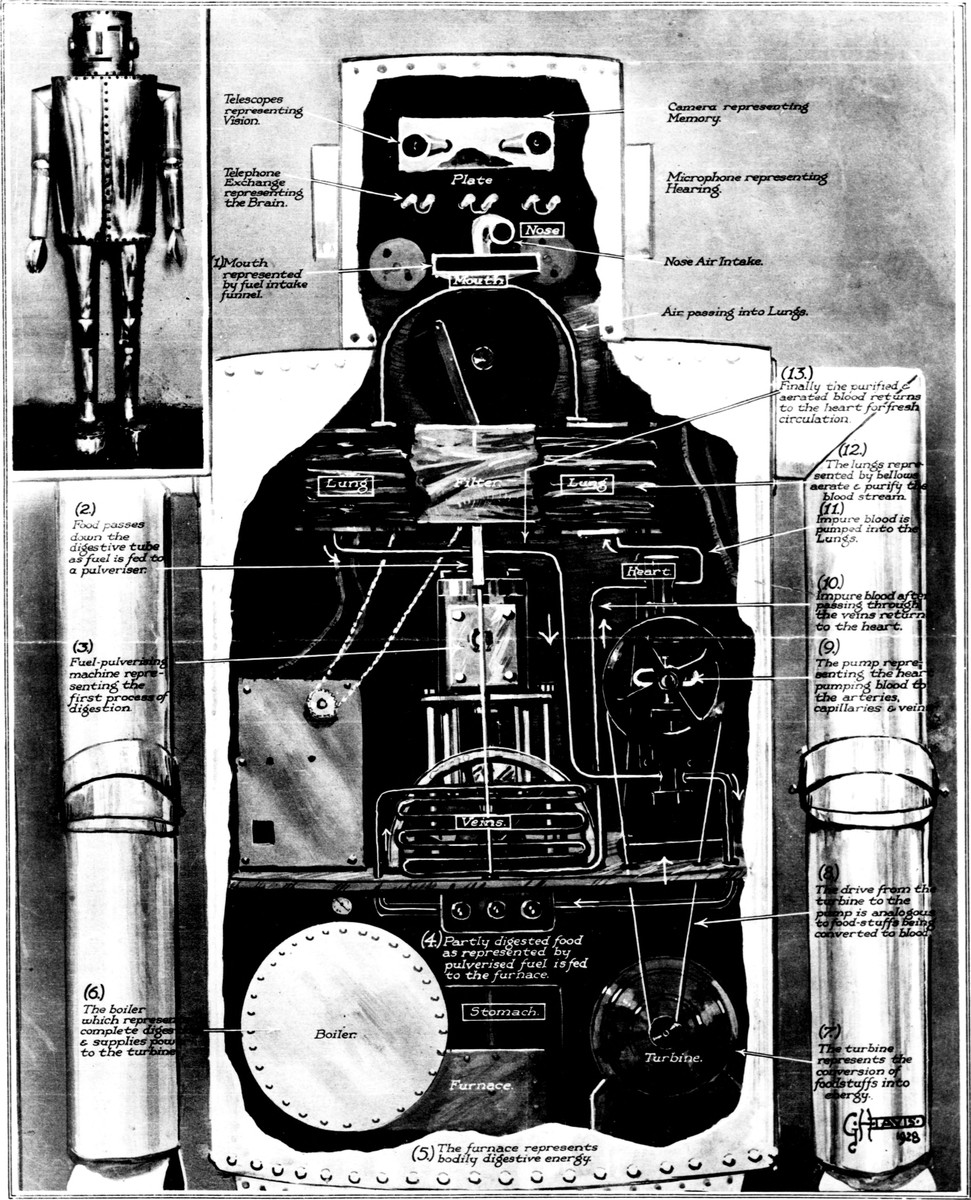
A cross-sectional anatomical diagram maps the human body onto industrial machinery in this remarkable 1928 illustration. A riveted metal robot stands at left while its cutaway torso reveals telescopes for eyes, a telephone exchange brain, bellows-lungs, a furnace-stomach, a turbine converting food to energy, and a pump-heart circulating blood through labeled veins and arteries. Thirteen numbered annotations walk the viewer through digestion and circulation as mechanical processes — retro-futurist biomechanics rendered with clinical precision and gothic industrial drama.
Less sensational than a tentacled pulp cover but far stranger — the cold clinical logic of mapping a boiler-room onto the human bloodstream is its own kind of delirium. Harold's diagram is the polite, educational face of 1920s techno-mania, and it's deeply weird for it.
“Telescopes representing Vision. Camera representing Memory. Telephone Exchange representing the Brain. Microphone representing Hearing. (1) Mouth represented by fuel intake funnel. Nose Air Intake. Air passing into Lungs. Plate. Nose. Mouth. Lung. Filter. Lung. Heart. Veins. Stomach. Boiler. Furnace. Turbine. (2) Food passes down the digestive tube as fuel is fed to a pulveriser. (3) Fuel-pulverising machine representing the first process of digestion. (4) Partly digested food as represented by pulverised fuel is fed to the furnace. (5) The furnace represents bodily digestive energy. (6) The boiler which represents complete digestion & supplies power to the turbine. (7) The turbine represents the conversion of foodstuffs into energy. (8) The drive from the turbine to the pump is analogous to foodstuffs being converted to blood. (9) The pump representing the heart pumping blood to the arteries, capillaries & veins. (10) Impure blood after passing through the veins returns to the heart. (11) Impure blood is pumped into the Lungs. (12) The lungs represented by bellows aerate & purify the blood stream. (13) Finally the purified & aerated blood returns to the heart for fresh circulation. G Harold 1928”