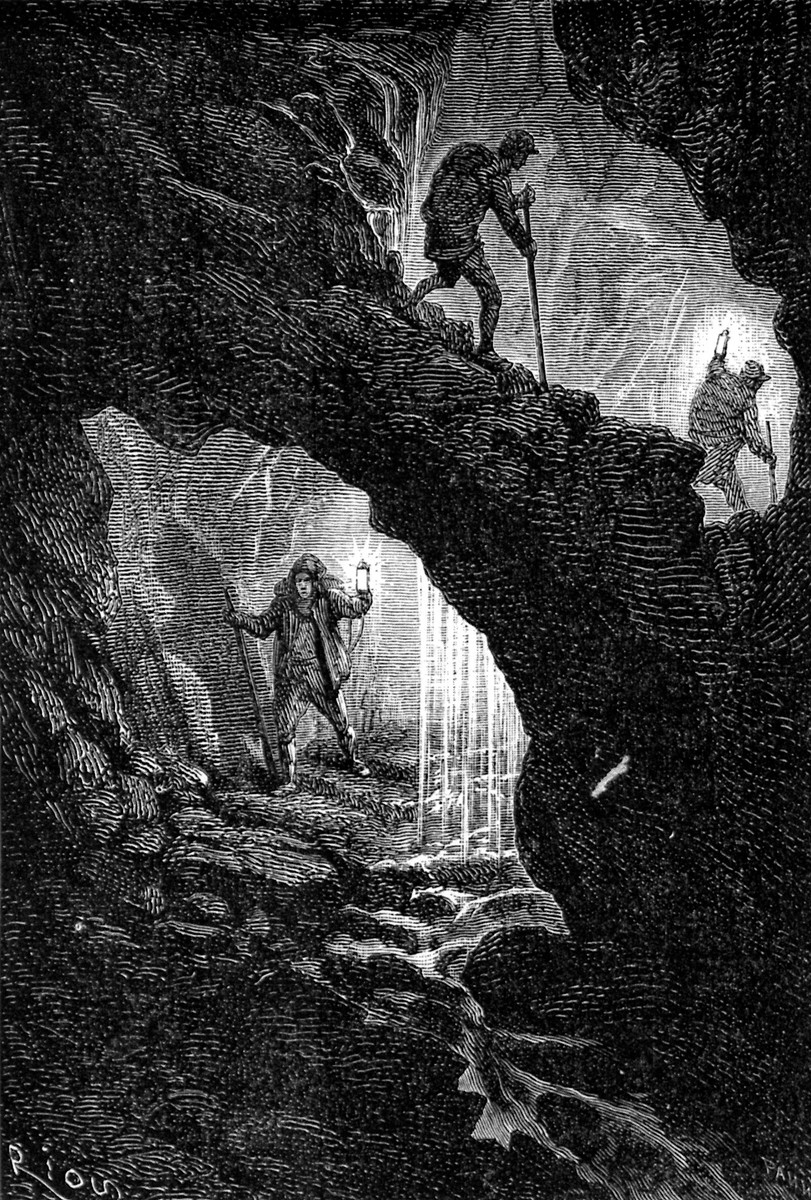
Édouard Riou's Subterranean Explorers, Journey to the Center of the Earth (1864)
At the height of Victorian scientific romanticism — when geology was upending biblical timelines and exploration fever gripped Europe — Jules Verne's underground adventurers embody the era's hunger to penetrate nature's last mysteries. Three figures descend through a cathedral-like cave passage, one holding a lantern whose light fractures against crystalline waterfalls, another silhouetted dramatically atop a rock arch. The scene pulses with subterranean sublime, rendering the Earth's interior as simultaneously terrifying and magnificent.
Masterfully atmospheric and dramatically composed, this engraving favors Gothic naturalism over sensationalism — the pulp DNA is proto-pulp at best, rooted in Victorian scientific romance rather than lurid magazine spectacle. The subterranean sublime is compelling but restrained.
“Riou”