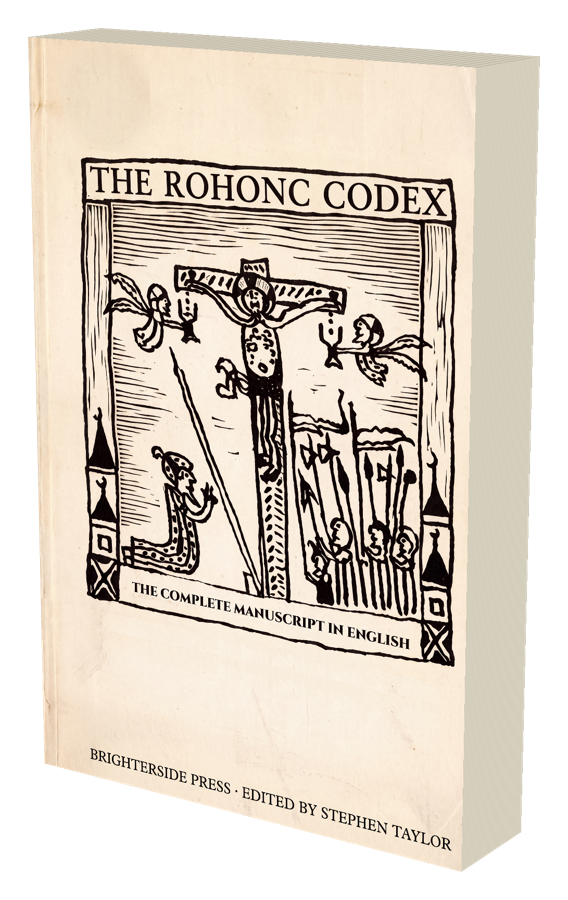
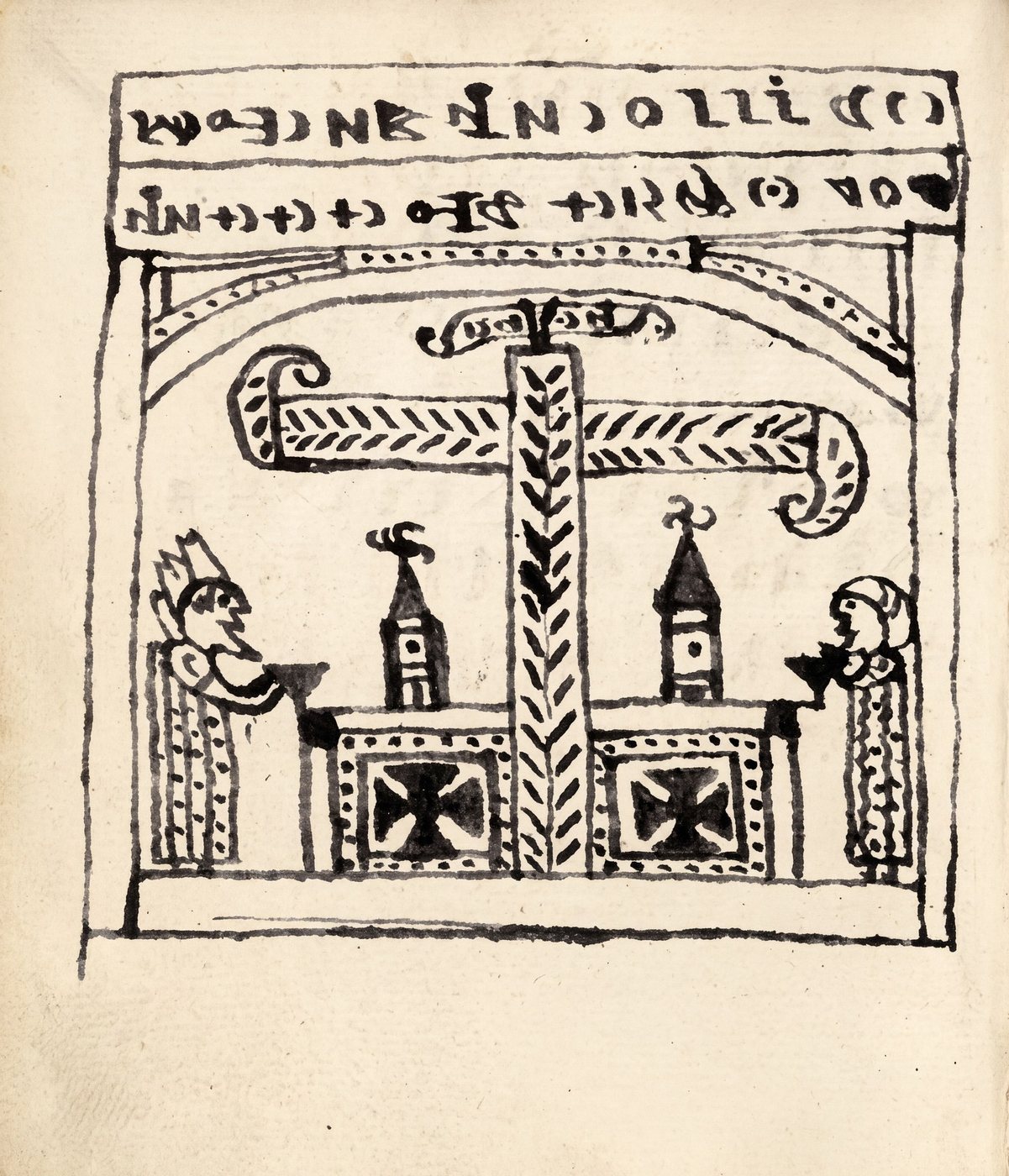
The Rohonc Codex is a small paper book of the sixteenth century, kept at the Library of the Hungarian Academy of Sciences in Budapest. The book is written in a script that occurs in no other document.
Levente Zoltán Király and Gábor Tokai established what the book contains. They published a dictionary of 841 signs and the grammar. The book contains the apocryphal Life of Adam and Eve running into the legend of the Rood, the story of Joachim and Anne, a Passion the codex itself says it takes from Matthew and John, sermons and parables for the gospels of the year, the Finding of the Cross, the Acts of the Apostles, and at the end a few pages of one man's diary. The frame is a revelation where an angel of God speaks and the prophet Elijah is the one addressed.
This project started from the Király and Tokai dictionary. It tested the dictionary and extended it.
This was done with AI, under an editor. Anthropic's Claude proposed readings for the remaining signs, using the Király and Tokai dictionary as a foundation. Different models assembled the gloss and composed the translation.
The book is in two parts. Book Two is the gloss: the manuscript folio by folio, line by line, every word marked for how well it is known. That is the evidence. Book One is the translation: a reading of the gloss into continuous English, made against the books the codex is compiled from, with every paragraph linked to its folios. Where the two disagree, Book Two is right.
We found one external test to validate the signal. Everything here reads the transcription Király and Tokai made, so no test of this project's could catch an error in it. An anonymous transcription of the codex published in 2014 — a different person, a different glyph alphabet, no word division, four years earlier — agrees with it on 91.1% of the glyphs that can be compared, against 12.9% for the same rows paired at random, and on 83.8% of the words this edition reads. Our understanding is the two share no common root but the book. The scan's spreads even line themselves up unasked, in the order a right-to-left book falls open.
This is an attempt, not peer reviewed, and published to be checked. As of now, the tests, for what they are, find it internally consistent. Tests and all programs and documents are in the repository at https://github.com/styopr613/rohonc-codex.
All 441 folios · 553 pages · the translation and the evidence in one volume.
the Baptist / woman520 060 131
The strip shows signs from the manuscript. The script runs right to left. Drag it, or use the arrows: the glass magnifies whatever sign passes under it and names this project's reading of that sign and its code. The outlines are drawn from Király and Tokai's own font. More about the script →
How far it reads
The manuscript contains 29,997 words. The project has a reading for 94.1% of them. 2.5% of all words are read from one passage only. 3.3% are restored in brackets. 0.2% are dark. 81.5% of lines have every word read. Lines are 98.9% complete once brackets are counted.
This project's own readings, in its dictionary, by tier:
The dictionary of added readings has 1787 entries. They are graded by how well they are known. Tier A readings survive every place the sign stands in the book, or are proved by an identical formula or a numeral. Tier B readings survive most places, with the rest unclear rather than against. Tiers C and D are read from one passage with nothing inside the book able to refuse them. Tier G is a guess, printed in brackets, and counted as read nowhere. 21 withdrawn readings stay in the file with the reason they went.
What is new here and what is not
The following paragraph states what is new here and what is not.
The grammar is Király and Tokai's: they describe it, and they print the you-Mary example this work started from. What is new is that the construction is confirmed independently of their glosses, at 12.4 and 9.8 sigma against matched controls, and then applied across the whole book to produce 1,282 readings their published dictionary does not contain. The check that matters ran in the other direction too: the composition rule, applied blind to folio 137v, reproduces their published line — sin, without, Jesus, conceive, you-Mary — in order.
Is it true?
The project ran tests to check its own readings. Every test's bar was declared before it ran. Failures are recorded beside passes. The summary table shows the results.
| test | what it asks | result | verdict |
|---|---|---|---|
| The transcription every other test reads, checked against an independent one: | |||
| Test 16 | a second, independent transcription | 91.1% of glyphs agree where both can be compared, against a 12.9% control, 458.5 sigma; 83.8% of the words identical | PASS |
| The readings: | |||
| Test 1 | source presence, held-out folios | A+B 16.4 sigma; 99% of K&T's own rate | PASS |
| Test 5 | K&T's own sentence translations | A+B 8.6 sigma; 153% of K&T | PASS |
| Test 6 | word order, held-out folios | A+B 7.1 sigma | PASS |
| Test 2 | part of speech from context | the instrument fails on K&T's own words (68.3% against a needed 70%; 4.7 sigma against a needed 5); the readings were never scored | NO VERDICT |
| Test 3 | the blindfold, run clean | 4 of 24 strict, 16.7%; the declared band for that result was 15-30%, and its declared consequence, tier C passage readings become tier D, was applied | IN BAND |
| Test 7 | K&T's words removed | reads 11.6% from ours alone, by design: the readings extend the dictionary. Recovery of a hidden K&T word: 10.3 sigma against a declared 5, on a hundred-shuffle control; the ten-shuffle runs gave 4.4 before the variant fix and 8.4 after, and all three are kept | PASS |
| Test 8 | bootstrap from a random 30% | passage 37.6 sigma (6.1% absolute); recovery 15.3 sigma (1.0% absolute) | PASS |
| Test 9 | hidden 70% validated by the 30% | A+B 6.9 sigma; 115% of K&T's own rate | PASS |
| After the outside review by Gemini 2.5 Pro and Grok 4.7, same day: | |||
| Test 11 | passage map from K&T's words alone | median rank 25 of 1,334; top-1 12.4%; p 2e-28 | PASS |
| Test 10 | the search replayed on null books | 7 / 215 / 2 signs kept at three scales; the count rule has no power at any, so it cannot tell a search from a decipherment | NO VERDICT |
| Test 10, held out | the same runs, scored where the readings were not derived | real book 8 sigma over shuffle; null books none | reported, not a verdict |
| Test 12 | Test 5 rescored under the strict rule | 73.7%, 8.4 sigma; but +22.9 points over K&T's own headwords trips the declared leakage clause | FAIL on that clause |
| Test 12b | two independent re-glossers, Gemini 2.5 Pro and Grok 4.7 | given K&T's words only and the sign blanked, they recover our gloss 68.4% and 71.1% of the time | PASS |
| Test 13 | the underdetermination census | 61 of 94 A/B readings have a common verb present in every chapter their folios cite, against a bar of 40% | FAIL |
| Test 13, the same rule | applied to the chosen glosses | 0 of the 94 pass it. The rivals exist; the method did not choose them. The FAIL measures the rival space, not what the method did | reported, not a verdict |
| Test 14 | the blind rotated run, outside reader | rotated book 0 fills, 0 matches; real book 3.8 fills a page, 13 of 18 | PASS |
| Test 15 | passage identification, outside reader | chapter level 9 of 20 against 0 of 20 shuffled; p 0.002 | PASS |
| PASS and FAIL are verdicts on the readings against a bar declared before the run. NO VERDICT means the instrument failed its own check on Kiraly and Tokai's words, or has no power to tell a search from a decipherment; it says nothing about the readings either way, and it is kept on the page because it was specified. IN BAND is a test with declared bands rather than a bar: the result fell in the band it was predicted to, and the consequence declared for that band was applied. | |||
What each test asked is on the tests page. The saved runs are in the data.
What is here
The edition
The book edition is in two parts. Book One is a reading edition. It is an interpretation, not a word-for-word rendering. Book Two is the gloss itself, all 441 written pages line for line with every mark. Where the two disagree, Book Two is right.
Credit and position
The manuscript is out of copyright. Király and Tokai's dictionary, transcription and page images are theirs. The readings, tests, English and editorial matter are this project's own. The programs are MIT and the data is CC BY 4.0, so nobody who wants to check the work is restricted; the translation and the editorial prose are CC BY-NC-ND 4.0, which allows reading, quotation and non-commercial republication whole, and reserves the commercial rights to the English text. Every figure on the site is read out of a saved run.
Their site: rechnitzer-kodex.hu. Citations owed and the terms of every source are under Sources.
This rests on the Király and Tokai dictionary; their translation is unpublished; the readings here are this project's own.